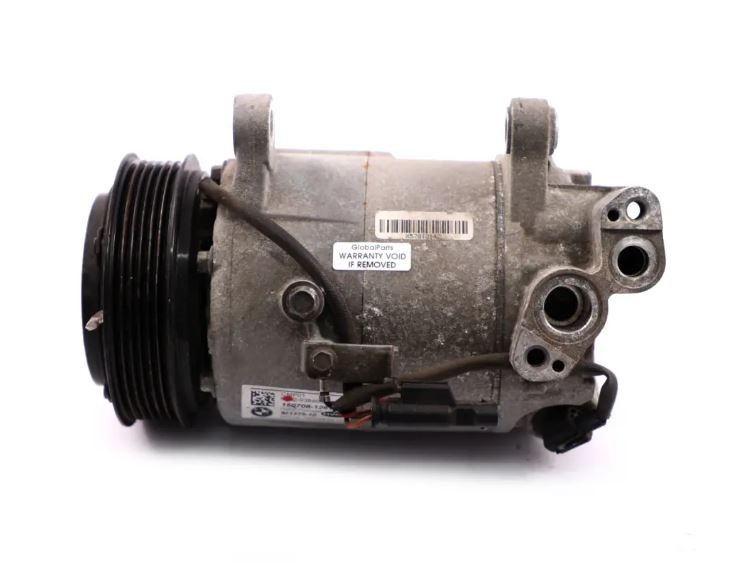
The air conditioning compressor is one of those components that drivers only remember when a lukewarm breeze blows from the vents instead of cool air. The problem can be particularly bothersome in the summer, but failure alone doesn't always mean the entire system requires a costly rebuild. In many cases, a sensible solution is an original used compressor, selected for the specific vehicle model and tested before installation. This choice allows for the factory fit of mounts, connectors, pulleys, and controls—elements that can vary in detail between aftermarket parts. Readers will gain practical tips on how to distinguish a compressor failure from a problem with the refrigerant, sensor, or condenser. At Global Parts, you can subtly verify the availability of the correct part and compatibility with a specific model without having to guess based solely on the component's appearance.
Contents:
- Air conditioning compressor – what is it in a car for?
- No cooling in the car – when is the air conditioning compressor to blame?
- Used OEM air conditioning compressor or new replacement – what to choose?
- Air Conditioning Compressor for BMW, Opel, VW and Mercedes – Why Are Part Numbers Important?
- How to repair the cabin cooling system when the air conditioning compressor is not working?
- Installing a used air conditioning compressor – what should not be missed?
- Air Conditioning Compressor FAQ

Air conditioning compressor – what is it in a car for?
The air conditioning compressor does not "produce cold," but forces the refrigerant to circulate and extract heat from the cabin. This is why a functioning compressor is the heart of the A/C system, and its failure quickly results in a lack of cooling. The compressor draws in refrigerant in the form of a gas at lower pressure, compresses it, and then directs it to the condenser, where it releases heat outside the vehicle. In practice, this means that the cabin cooling system operates as a closed circuit, with each component performing a specific role: the compressor builds pressure, the condenser releases heat, the dryer filters moisture, and the evaporator cools the air entering the cabin. In cars with conventional drivetrains, the compressor most often operates via an accessory belt, an electromagnetic clutch, or a pulley with a safety element. Newer cars also feature variable displacement compressors controlled by a control valve, which improves the smooth operation of the air conditioning system. Therefore, the same symptom—a lack of cold air—can have various causes and should not be diagnosed solely by ear. A proper assessment requires checking the pressure, refrigerant volume, leaks, and electrical signals.
Air conditioning compressor – structure and typical components
The design of the air conditioning compressor is subordinated to one purpose: to compress the refrigerant in a stable manner and cooperate with the rest of the installation without excessive resistance. Depending on the design, a compressor may include a housing, drive shaft, pistons or vane mechanism, valves, a pulley, a clutch, or a capacity control valve. In systems using R134a or R1234yf, the correct oil is also crucial, as the compressor is lubricated in conjunction with the refrigerant circulation. Too little oil accelerates wear, while too much can reduce cooling efficiency and burden the system. Therefore, when replacing a component, installing the mechanical part is not enough—it's also necessary to check the system for cleanliness, oil level, and compatibility with the refrigerant type. This is especially important after a seized old compressor, as swarf can enter the lines, condenser, and expansion valve. In this case, without flushing the system, a newly installed compressor can quickly fail again.
No cooling in the car – when is the air conditioning compressor to blame?
A lack of cooling in your car doesn't always mean a faulty air conditioning compressor. The compressor is one of the main suspects, but the problem is just as often caused by refrigerant loss, a leak, a dirty condenser, or a faulty pressure sensor. The most common sign of compressor failure is when the air conditioning system turns on and the fans run, but the system pressures don't change correctly. A metallic noise, clutch clicking, pulley drag, oil leakage at the shaft, or a lack of response to a control signal may be present. In compressors with an electromagnetic clutch, the mechanic typically checks whether the clutch disc engages when the A/C is started. In valve-controlled compressors, reading diagnostic parameters and the response of the control valve are more important. If the system is low on refrigerant, the controller may deliberately prevent the compressor from starting to protect it from running dry. Therefore, a safe diagnosis begins with measurement, not immediate component replacement.
| Symptom in the car | Possible cause | What's worth checking out |
|---|---|---|
| No cold air from the vents | Low refrigerant level or compressor failure | Low and high side pressure, system tightness |
| Loud operation when A/C is turned on | Worn bearing, clutch, compressor seizure | Pulley, play, presence of filings, oil leak |
| The air conditioning only cools for a short time | Control valve, sensor or overheating problem | Computer diagnostics, fan operation, condenser |
| Compressor clutch does not engage | No signal, low pressure, damaged coil | Power supply, fuses, coil, pressure switch |
| Oil at the compressor or lines | A/C system leak | Leak test, inspection of seals and connections |
 | ||
| --- |
Used OEM air conditioning compressor or new replacement – what to choose?
A used, original air conditioning compressor makes sense when factory fit and predictable interaction with the vehicle's system are a priority. A new replacement may look attractive, but its quality depends on the manufacturer, manufacturing tolerances, and compatibility with the specific vehicle model. The biggest advantage of an original part from a dismantling operation is that it was designed for the specific system, not just "fits according to the catalog." This applies to the pulley diameter, number of grooves, electrical connector type, port location, oil type, and control valve characteristics. In cars such as the BMW E60, Mercedes W211, Opel Insignia, or VW Touran, a slight difference in the part number can indicate a different mounting or different control logic. Used compressors are especially worth considering if the car is several or a dozen years old and the owner wants to restore the air conditioning system without installing a random component. However, it's important to remember that a used part should be dry, complete, with no noticeable play or signs of wear. It's also a good idea to compare the OEM number, engine version, and air conditioning type before purchasing.
Used air conditioning compressor – advantages and limitations
A used air conditioning compressor is a reasonable alternative, but only if it is treated like a technical part and not a random off-the-shelf item. Advantages include factory compatibility, original mounting hardware, good integration with the wiring and controller, and a reduced risk of design differences. However, unknown operating history is a limitation, so the source and condition verification are crucial. Before installation, the mechanic should assess whether the old compressor has not disintegrated internally, as simply replacing the compressor will not remove the swarf from the system. If the previous failure was mechanical, it may be necessary to flush the lines and replace the dryer, expansion valve, or condenser. Otherwise, even a functional component can be damaged by debris remaining in the system. Therefore, it's safest to treat the compressor as part of a larger service procedure.
Air Conditioning Compressor for BMW, Opel, VW and Mercedes – Why Are Part Numbers Important?
The air conditioning compressor requires more careful selection than many simple body parts. The same car model may have different compressor versions depending on the engine, year, refrigerant, accessories, and market. For example, "BMW E46 air conditioning compressor" isn't enough, as different solutions may be available for the 320d, the petrol version, and still others after production modifications. The same applies to queries like "BMW E60 530d air conditioning compressor," "Mercedes W203," "Mercedes W211," "Opel Corsa D," "Opel Insignia," "VW Polo 9N," "Ford Fiesta MK7," "Peugeot 207," or "Nissan Qashqai J10." Differences may include bolt spacing, plug pin count, wire outlet direction, pulley diameter, and control type. In practice, the best filter is the number on the old compressor housing, followed by the car model and engine version. Selecting by VIN/OEM reduces the risk of errors, especially in facelifted or non-standard vehicles. At Global Parts, it's worth checking the part for technical compatibility, not just the model name.
| Sample user query |
| --- |
| BMW E90 air conditioning compressor |
| --- |
| BMW E60 530d air conditioning compressor |
| Opel Corsa D air conditioning compressor |
| Mercedes W211 air conditioning compressor |
| VW Polo 9N air conditioning compressor |
| Nissan Qashqai J10 air conditioning compressor |
BMW E46/E60/E90 air conditioning compressor – why is a similar model name not enough?
In BMWs, differences between compressors often stem not from the series itself, but from the engine, accessories, and production year. The BMW E46 320d air conditioning compressor may have a different configuration than the compressor used in the petrol version of the same generation. In the BMW E60 and E60 530d, the drive unit, production modification history, and pulley type also play a role. With the BMW E90, you should also be careful with facelifted versions, as a similar catalog name doesn't always mean an identical component. In practice, a mechanic should compare the part number, a photo of the mounting brackets, the shape of the ports, and the control connector. If the old component is still in the car, it's safest to read the marking directly from its housing. This approach reduces the risk of a situation where the compressor mechanically "almost" fits, but the system isn't working properly.
Opel Corsa D, Insignia, VW Polo 9N air conditioning compressor – when does the mounting differ?
In popular city and fleet models, the differences are often less visible in photos, but very important during installation. The Opel Corsa D air conditioning compressor may come in different versions depending on the engine, while the Opel Insignia has different requirements depending on the drivetrain and accessories. In a VW Polo 9N or VW Touran, attention should be paid to the belt layout, the number of grooves, and the location of the ports, as the air conditioning hoses have limited range of motion. A similar issue with the Ford Fiesta MK7 or Peugeot 207 concerns the electrical connectors and the manufacturer of the factory compressor. Externally, two compressors may look almost identical, but differ in details that prevent a tight fit. Therefore, the model description should be considered a starting point, not the only purchase criterion. Ultimately, compatibility with the specific vehicle configuration is what matters.
How to repair the cabin cooling system when the air conditioning compressor is not working?
The cabin cooling system is repaired in stages: first, diagnosis, then removal of the cause, and only then replacement of the air conditioning compressor. If the problem is related to engine overheating, the engine cooling system, including the radiator, coolant pump, thermostat, and fans, must be diagnosed, as the A/C compressor alone will not correct the engine temperature. In the case of air conditioning, the first step is to check whether the system has the correct amount of refrigerant and whether the system is leak-free. Next, the mechanic assesses the operation of the fans, condenser, pressure sensor, expansion valve, and compressor control. If pressures are not building properly and the system is tight and charged to specifications, the suspicion of compressor failure increases. In cars with valve-controlled compressors, a distinct engagement sound is not always audible, so simply observing the clutch is not sufficient. If seizure is suspected, additional checking for filings is necessary, as a contaminated system can damage another component. A/C system repairs should be performed by a service center with a refrigerant recovery unit, as refrigerant cannot be released into the atmosphere.
Air Conditioning Compressor – Safe Diagnosis Procedure
A safe diagnosis of an air conditioning compressor involves checking the entire system, not just the compressor itself. First, the service center reads errors and air conditioning operating parameters, as the controller may be blocking activation at too low or too high a pressure. Next, the refrigerant charge, leaks, and condenser fan operation are checked. The next step is to measure the pressures on the low and high sides, ideally at a specific ambient temperature and with the maximum cooling setting. If the compressor is noisy, jammed, or doesn't produce a pressure difference, replacement may be warranted. If the system is empty, the first step is to find the leak, as installing a working compressor to a leaky system won't solve the problem. This approach protects both the car owner and the newly installed part.
Installing a used air conditioning compressor – what should not be missed?
Installing a used air conditioning compressor shouldn't be limited to simply unscrewing the old part and screwing in the new one. Most common errors result from omitting the dryer, oil, system flushing, or checking the root cause of the failure. Before installation, it's important to compare the part numbers, mountings, plug, pulley, diameter, and port configuration. Next, the service center should assess the condition of the hoses, condenser, and dryer, as moisture and contamination are very dangerous for the compressor. If an old compressor has seized, simply replacing the component without flushing it can lead to a recurrence. The correct oil volume is also crucial, as different systems require different volumes and types of lubricant. After installation, a vacuum is performed, a leak test is performed, the refrigerant is filled with the correct refrigerant according to the vehicle's plate, and the airflow temperature is checked. Only then can it be determined whether the cabin cooling system has regained its proper efficiency.
| Assembly stage | Why is it important? | Risk of omission |
|---|---|---|
| Part Number Comparison | Confirms compatibility of mountings and controls | Bad compressor, leak, not turning on |
| Oil check | Provides compressor lubrication | Seizure, noise, decreased durability |
| Replacing the dryer during a major repair | Removes moisture from the system | Corrosion, freezing, unstable operation |
| Rinsing after scuffing | Removes filings and dirt | Another compressor failure |
| Vacuum and leak test | Verifies tightness before filling | Loss of refrigerant, no cooling |
| Filling as per specifications | Ensures proper operating pressure | Poor cooling or system overload |
Air conditioning compressor and parameters worth checking before purchasing
Before purchasing an air conditioning compressor, the most important thing is to know the specific technical data, because the photo of the part does not always show all the differences. It's worth checking the housing number, factory manufacturer, refrigerant type, oil type, number of pulley grooves, pulley diameter, electrical connector type, and port orientation. The engine version is also important, as different accessories may require different mounting geometry. In cars like the Scenic air conditioning compressor, Mercedes W203 air conditioning compressor, or Ford Fiesta MK7 air conditioning compressor, the model name itself is often too broad. Selecting by VIN/OEM is particularly useful if the car has had multiple compressor suppliers. It's also worth checking whether the kit includes the components shown in the photo, such as a pulley or clutch, if the specific model uses them. These are minor details, but in a workshop, they determine whether the installation will be successful.
Air Conditioning Compressor FAQ: FREQUENTLY ASKED QUESTIONS
The most common questions about air conditioning compressors include whether the part can be repaired, how to identify a failure, and whether a used component is a safe choice. It's best to base answers on a diagnosis of the entire system, as a compressor rarely fails completely without prior symptoms.
| Question | Answer |
|---|---|
| Why does a car need an air conditioning compressor? | The air conditioning compressor compresses the refrigerant and forces it to circulate through the A/C system. This allows heat to be extracted from the cabin and released outside through the condenser. |
| How to repair the cooling system in a car? | First, determine whether the issue is the engine cooling system or the air conditioning/cabin cooling system. For air conditioning, check for leaks, refrigerant levels, pressure, sensors, and fans, and only then assess the condition of the compressor. |
| Is a used air conditioning compressor a good choice? | Yes, as long as it's original, matches the part number, is complete, and comes from a trusted source. The biggest advantage is the factory fit with mounting brackets, wiring, controls, and other system components. |
| What are the symptoms of a damaged air conditioning compressor? | Typical symptoms include lack of cooling, noise when the A/C is turned on, clutch failure, oil leakage, insufficient pressure differential, or intermittent air conditioning operation. These symptoms should be confirmed with measurements, as low refrigerant levels can cause similar symptoms. |
| Does the BMW E46 air conditioning compressor fit every E46? | Not always. The BMW E46 air conditioning compressor may vary depending on the engine, year, hardware version, and part number, so the model name alone is not sufficient. |
| Do I need to recharge the air conditioning after replacing the air conditioning compressor? | Yes, after replacing the compressor, the system should be drained, checked for leaks, vacuumed, and charged with the correct amount of refrigerant. The amount of refrigerant should be selected according to the vehicle's specifications. |
| If the compressor seizes, is it enough to replace just the compressor? | Usually not. Seizures can cause filings to appear in the system, so the service center should check the lines, condenser, dryer, and expansion valve, and if necessary, flush the system. |